
Welcome to issue 11. We hope you had a restful, well-deserved summer break. As a new school year begins, our mission is to ensure South Tyneside schools stay ahead of the curve. Whether you are an AI novice or an AI expert, this is your weekly home for the tools and digital principles defining the future of education. Each week, we’ll deliver three or four essential updates ranging from DfE policy shifts to time-saving classroom hacks specifically curated to reduce teacher workload and enhance learning across our South Tyneside community as safely as possible.
Save the Date: Apple RTC Autumn Conference 2026
We are thrilled to announce that the Apple RTC Autumn Conference will be hosted live at The Word, South Shields on Thursday, 22nd October 2026!
This whole-day event will focus on two of the most critical topics in EdTech today: AI & Accessibility.
Join us to connect with educators and experts, discover innovative ideas and practical strategies, and explore inclusive approaches that empower every learner.
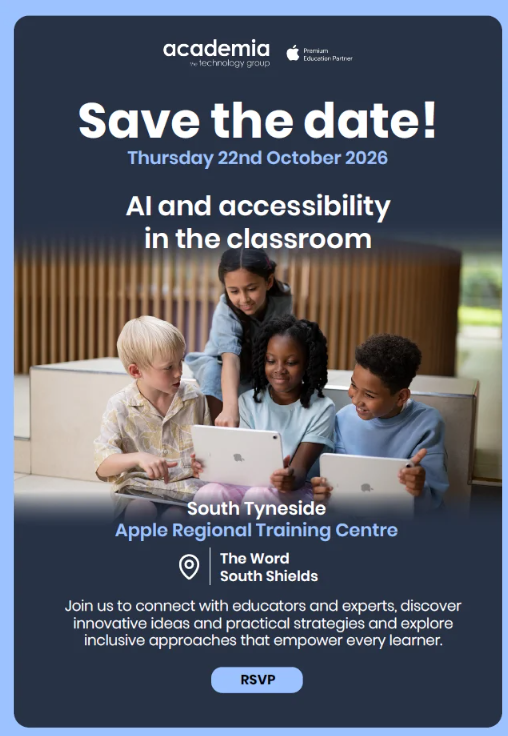
👉 RSVP:Click Here To Book A Place
AI Champions Work Group
Haven’t nominated an AI Champion yet? Click the link to access our nomination form: CLICK HERE
⚠️ CHANGE TO DATE – NOW Wednesday 18th NOVEMBER
- Next meeting: Wednesday 18th November 2026 (16:00–17:30)
- Venue: The Word
- Contact: Julia Small to book a place:[email protected]
Item 1: Overcoming “Shadow AI”: Keeping School Data Safe
- The Strategic Context: The Information Commissioner’s Office (ICO) and DfE repeatedly caution schools about “Shadow AI”—where well-meaning staff input pupil data, draft EHCPs, or upload student work into unvetted, consumer-grade AI platforms that use the data for model training.
- The Prompt Concept:(Try this prompt to create a staff memo)
“Act as a School Data Protection Officer (DPO). Draft a clear, clear-headed 1-page guidance memo for all teaching and operational staff titled ‘Safe vs. Unsafe AI Use’. Include a clear traffic-light framework (Red/Amber/Green) showing what data can never enter a public AI (e.g., named student work, medical data) vs. what is safe (e.g., anonymised lesson frameworks, public domain texts).” - The Strategic Value: Protects the school from data breach risks while still allowing staff to benefit from efficiency gains.
Item 2: Find the Fake Quizzes
On the Internet Matters website, hidden in a section on Fake News and Misinformation, there are four short quizzes that you may want to use with your KS2 or KS3 classes.
Choose a quiz to play from:
- What is AI?
- What is fake news?
- Fact or fake?
- Fact-check
Within each quiz, you’ll find age-specific options to ensure every child can learn at a level that’s right for them. Give yourself at least 10 minutes to play the quiz and discuss the answers with children.

👉 Click Here to Access Quizzes
Item 3: Classroom Resource: Common Sense Media’s Two Truths & AI
Looking for a low-prep way to build media literacy and critical evaluation skills with your pupils?
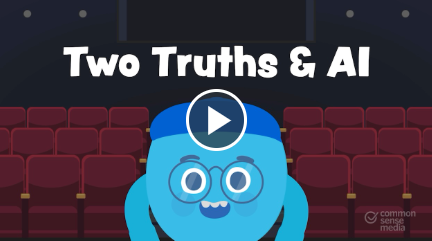
Common Sense Media’s Two Truths & AI is a free, web-based digital literacy game designed for K-12 (Key Stages 2–4)[cite: 4]. Based on the classic party game, students view three movie posters—two are authentic, and one is AI-generated. Click on image to access quizzes:
How to Use It in the Classroom:
- Whole-Class Warm-Up: Display the game on your interactive smartboard as a 5-minute starter for Computing or PSHE.
- Untimed Mode for Discussion: Switch off the timer and ask pupils to act as “AI Detectives.” Have them point out specific visual artifacts (e.g., strange text rendering, unnatural lighting, background distortions, or anatomical glitches) before submitting their vote.
- Connect to the Curriculum: Use the activity as a hook into wider lessons on digital verification, lateral reading, deepfakes, and critical thinking online.
Question of the Week
“In the week that an AI teacher was appointed in a Scottish school, do you think all schools will need an AI teacher in the future?”
Contact Us
If you have any questions or suggestions, please contact:
Steve Robert:[email protected]